Staging innovation: MindLabs
Joost Ector, EHA – Ector Hoogstad Architects
This article is published as a chapter in the book by Jacques van Dinteren and Paul Jansen (eds,) ‘Organised Innovation Spaces’. Nijmegen: Innovation Area Development Partnership (2026). The book will be digitally available in autumn 2026.
An ecosystem around AI, right in the heart of Tilburg
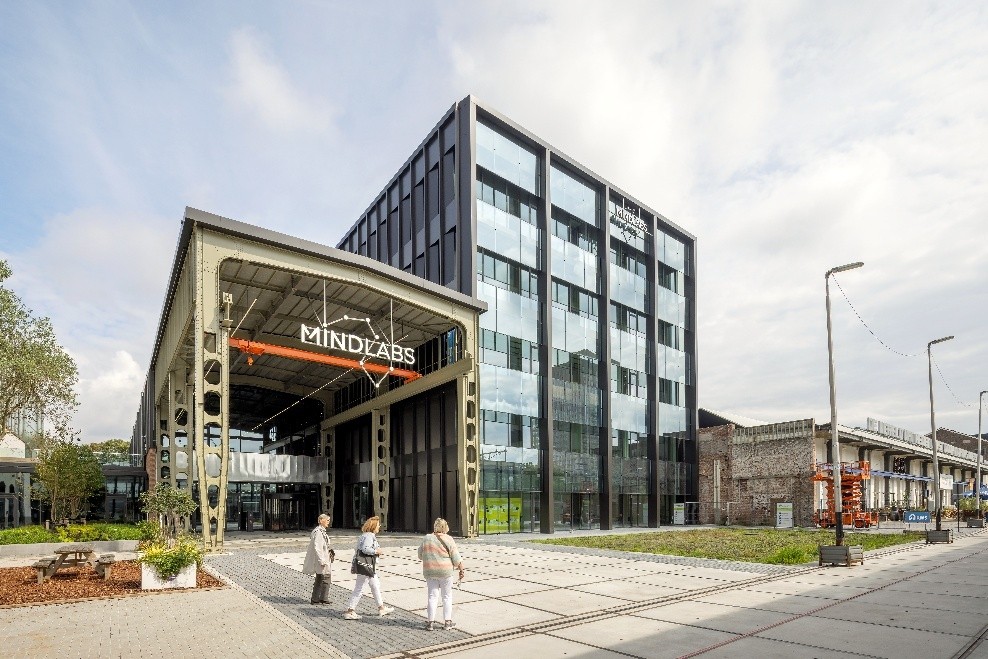
Directly north of Tilburg Central Station (the Netherlands), the so-called Spoorzone is being developed into a vibrant urban district featuring a mix of businesses, education, housing, and community facilities. Transformations of industrial heritage are combined with new construction. Right next to the well-known LocHal, which houses, among other things, the public library, the equally impressive Hal 70 has been redeveloped to serve as the centre of MindLabs, an intriguing ecosystem around ‘human-centred AI’ or technology that interacts with human behaviour. In addition to the founding partners (Fontys University of Applied Sciences, Yonder [formerly ROC Tilburg], Tilburg University, the Province of North Brabant, Municipality of Tilburg, and DPG Media (formerly Persgroep), an impressive and rapidly growing network of companies has already gathered in this ecosystem, together contributing to future economic development in Middle Brabant.
Architecture and heritage as a strong visual identity
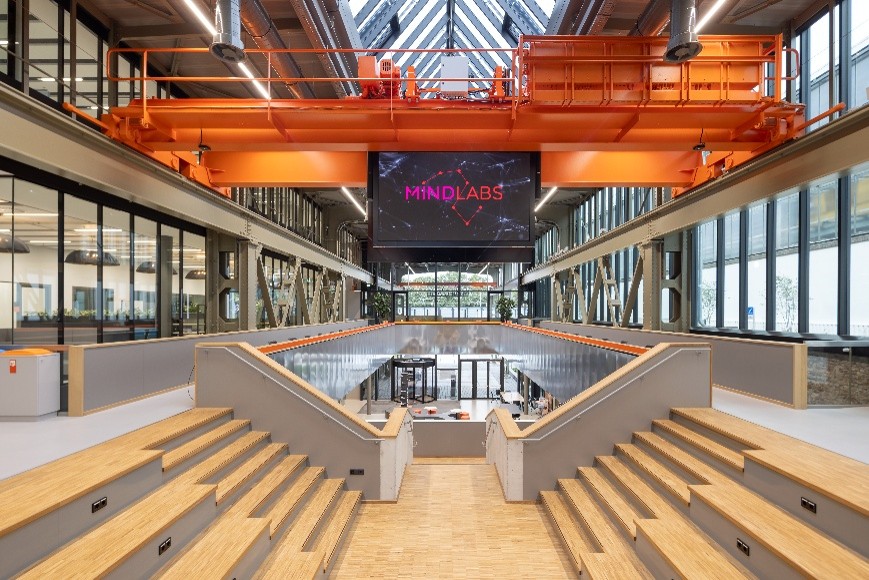
MindLabs comprises Hal 70, the former locomotive maintenance hall, and an adjacent new wing. With its imposing, cathedral-like dimensions, the hall is the heart of the complex. From the outset, the design has aimed to transform it into a ‘marketplace for knowledge’. All users enter through this central hall, where participants present themselves and where shared facilities, including the MindLabs café, are arranged around the space. In the lofty volume, a new walkway provides study spots, reached via a central staircase. Above the stairs, suspended from an original crane track, a large LED screen supports presentations. The new additions are deliberately contemporary in form and materials, contrasting with the historic steel frame, making the hall’s interior a distinctive identity carrier.
Bringing the outside world in
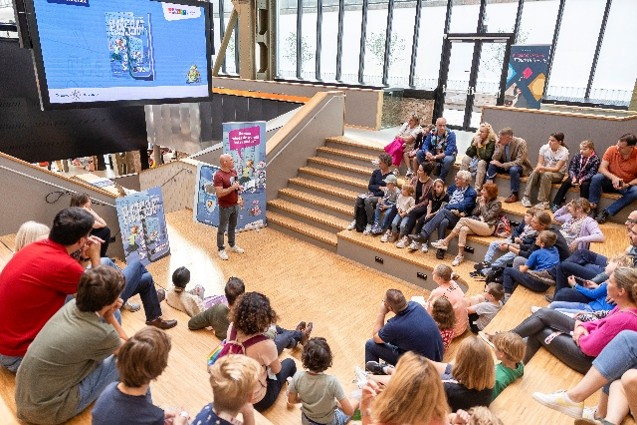
Thanks to strong accessibility, a clear visual identity, an inviting atmosphere, and high flexibility for various uses, MindLabs’ hall has already hosted numerous events. Parties, election debates (including the ‘Debate of the South’ in the run-up to the 2025 parliamentary elections), information markets, and talk shows such as NPO’s ‘College Tour’ all naturally gravitate to the heart of MindLabs. A very active management organisation also drives this success. With many visitors flowing into the building’s core, the connecting role of this knowledge landscape suddenly becomes more effective.
Flexibility offers usability and future value
The new wing demonstrates future-proof flexibility through generous floorplates and carefully planned services that support multiple layout options. Building on our earlier successful work with Fontys University of Applied Sciences, our recommendation for an additional floor-to-floor height was again adopted, enabling experimental use and creating a comfortable sense of space. Vertical links and circulation zones are arranged to enable each level to be divided into multiple independent business units. Wherever feasible, partitions are transparent, allowing occupants to contribute visibly and inspiringly to MindLabs’ diverse community.
Architecture of inspiration and serendipity
Perhaps the most remarkable and illustrative aspect of this specific knowledge landscape is located on the first floor. Here, the upper part of the central staircase has been developed into an arena for debates and presentations, fully open in the heart of the hall and at the intersection of routes for all users. This feature was never part of any requirements program and was never requested explicitly by anyone. We designed the arena as a modest experiment around the added value of architecture for open knowledge sharing. The results have far exceeded our expectations. The arena is used daily by users and visitors for lectures, presentations, and group discussions. It is fascinating and inspiring to see how freely users linger or even join in, absorbing new knowledge and insights as they stumble upon them. This provides some further proof of the value of good architectural design as a catalyst for creativity, inspiration, and serendipity. That is what drives us – and we love making it work!