Laborec Innovation Campus
Brecht Lootens, ORG / With Purpose Ecosystem Studio
This blog is published as a chapter in the book by Jacques van Dinteren and Paul Jansen (eds.) ‘Organised Innovation Spaces’. Nijmegen: Innovation Area Development Partnership (2026). The book will be digitally available in autumn 2026.
Hybrid work, rising energy costs and the demand for meaningful workplace interaction are reshaping industrial R&D campuses. The emphasis is moving from maximising surface to optimising quality: environments that bring people together while reducing vacancy and energy use; key conditions for innovation and sustainability.
The Laborelec site in Linkebeek, near Brussels, is a case in point. Founded in 1962 by Belgian electricity companies to advance applied research in electrical power, Laborelec has since become an ENGIE centre of excellence, with global operations across the electricity value chain. Over time, labs and offices were added to host up to 400 specialised engineers and technicians, but without an overarching spatial vision. ENGIE-Laborelec invited ORG to support the transformation into a ‘sustainable home for the future of energy’: a flagship project that translates ENGIE’s mission of accelerating the transition to a carbon-neutral economy.
ENGIE Laborelec provides customised solutions for the sustainable energy transition that are reliable, scalable, and cost-effective, actively contributing to and accelerating it.
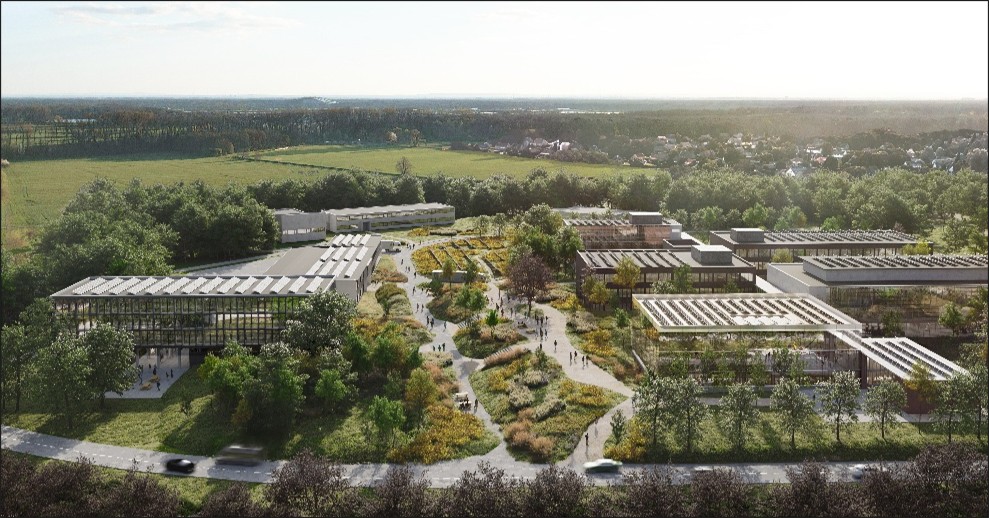
ORG identified assets: a central location, deep technical infrastructure, and a community with decades of applied R&D expertise and partners throughout Europe. ORG reframed the site as an organised innovation space for the energy transition: open, multi-actor and collaborative. A dual-track strategy combined an ambitious but grounded spatial concept with ecosystem analysis and market validation. The result is a master plan that positions the site internationally as a flexible testbed, a multifunctional workplace, and a collaboration platform designed to support next-generation energy innovations.
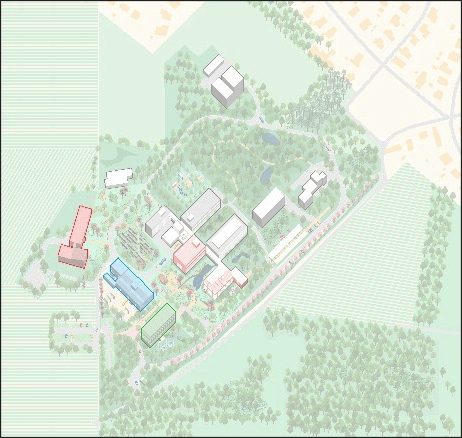
The masterplan reuses and reconnects three existing assets as thematic hubs: an Office Hub with flexible co-working and shared workspaces; a Lab Hub with modular infrastructure for applied R&D and prototyping; and a Green Campus, a central landscape that links the site, encourages informal interaction and enhances biodiversity. Functions are clustered for clarity, synergy and proximity, improving circulation and strengthening identity.
Sustainability is embedded through the Reduce, Reuse, Recycle framework: maximising building reuse, minimising emissions and construction waste, and reducing environmental impact. Across the Green Campus, buildings B, D and E are positioned as platforms for new collaborations (between Laborelec and partners, between research and industry, and between energy and digital systems), allowing the mission to scale without new construction.
To pair physical change with strategic repositioning within Europe’s energy innovation landscape, ORG applied a five-layer ecosystem model: Purpose & Value (shared mission for energy transition and resilience), Community & Governance (co-developed rules and inclusion), Digital & Data (dashboards, digital twin, campus platform), Services (lab support, innovation services, daily operations) and Physical Space (modular infrastructure for co-location). This systemic lens shaped not only buildings but also interactions, community, and collaboration.
Market alignment was tested through structured validation. From a longlist of 200+ leads, 20 key players were interviewed, including clean-tech scale-ups, science parks, corporate R&D centres, and lab operators. Findings confirmed demand for shared lab space, co-location and support services beyond real estate. Leads were assessed for ecosystem fit, prioritising complementarity over short-term occupancy.
The roadmap is phased. In the short term, the Office and Lab Hub act as attractors, with Laborelec as the initiating Anchor Tenant; the Green Campus forms the spatial backbone. A semi-open governance model is foreseen, curated by Laborelec and, later, potentially supported by a neutral facilitator. Next is coalition-building with public and private actors ready to co-invest, co-locate or co-develop shared programmes around energy innovation and infrastructure.
The Laborelec Innovation Campus exemplifies an industrial innovation campus: a peri-urban site with specialised technology and infrastructure, a clear mission, and openness to a curated network of complementary actors. The case shows that transformation requires deliberate alignment of spatial design, ecosystem analysis, and stakeholder engagement, thereby combining design, data, and diplomacy to unlock place-based innovation.
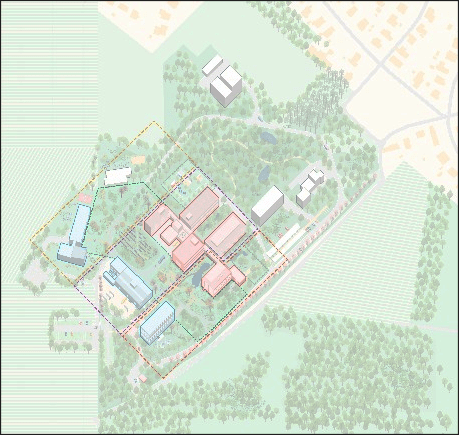
Phase 1 of ORG’s Laborelec Innovation Campus Masterplan focuses on transforming buildings A1 (red) and A3 (yellow) into state-of-the-art Office Hub and Lab Hub. These upgrades are complemented by a central connector designed to encourage informal meetings and collaboration across departments. It links all ENGIE and Laborelec facilities, providing high-quality circulation and creating a new social heart for the campus.
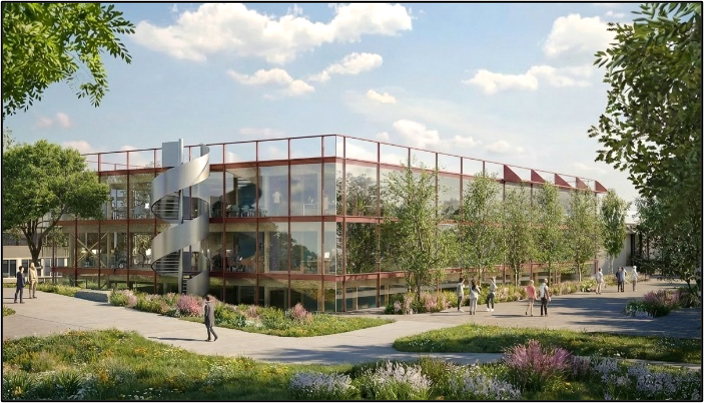
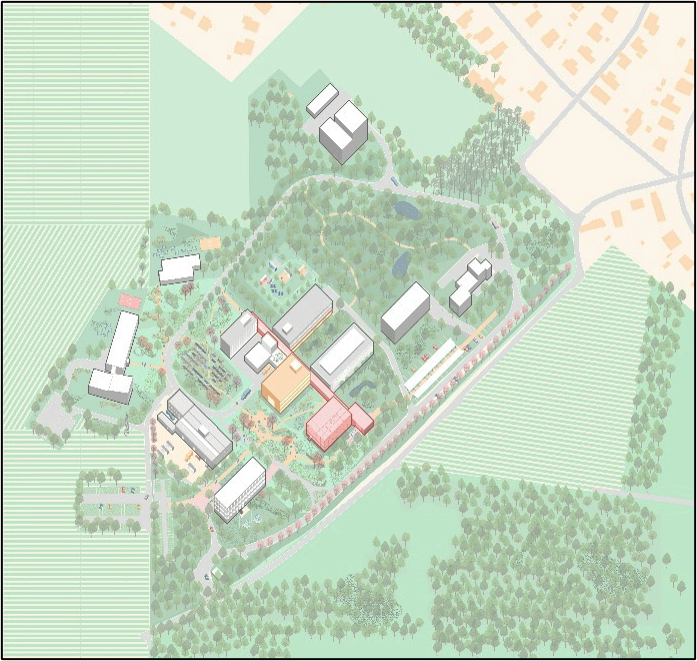
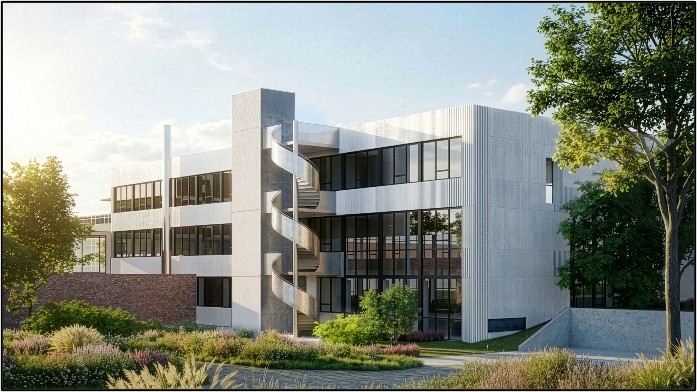
Once the Lab and Office Hub are operational (red zone), and after internal relocations and the creation of the Green Campus (green zone), three buildings (blue zone) will become available for development by external partners.
- The landmark office building at the campus entrance offers strong potential as a co-working and meeting hub, with space for conferences, events and supporting functions such as hospitality.
- The centrally located research building includes both individual labs and testing rooms as well as a large industrial hall with excellent logistics access; ideal for prototyping and hardware testing.
- The third building, situated at the rear of the campus, remains flexible and can accommodate various uses: additional workspace, support services or even dedicated technical infrastructure such as a data centre.