
A conceptual framework for developing and managing organised innovation spaces
Paul Jansen, Arup / IADP
This article is published as a chapter in the book by Jacques van Dinteren and Paul Jansen (eds,) ‘Organised Innovation Spaces’. Nijmegen: Innovation Area Development Partnership (2026). The book will be digitally available in autumn 2026.
This article proposes a practice-oriented conceptual framework for organised innovation spaces by translating the economic–social-physical asset model into six interrelated pillars. Three substantive pillars (economic, social, spatial) show how entrepreneurship, knowledge valorisation, collaboration networks, talent development and spatial environments combine into an integrated ecosystem, treating entrepreneurial lifecycles, relational capital and inclusive learning, and the design of real estate, public realm, infrastructure and digital connectivity as active instruments rather than backdrops. Three organisational pillars (governance, financing, impact) shape strategic direction, joint investment capacity, continuity and ecosystem learning over time: collective multi-stakeholder leadership and decision-making; area-wide business cases, diversified funding and support for ‘invisible infrastructure’ (community and programme coordination); and impact as multi-value, driven by iterative feedback, learning and strategic recalibration instead of static reporting. The framework is not a universal blueprint but enables adaptive, context-specific development aligned with local conditions, collaboration and long-term regional anchoring.
Organised innovation spaces have become a prominent policy and development focus in many regions. However, despite their growing popularity, the underlying concept is often used inconsistently, with some approaches emphasising primarily spatial interventions and others focusing on economic performance or community dynamics. This article, therefore, starts by clarifying the conceptual foundations that have shaped contemporary thinking about these spaces. A helpful point of departure is the shift in urban innovation theory that positioned innovation not as the outcome of a single domain, but as an ecosystem effect produced by the alignment of multiple asset types.
The development of a conceptual framework for understanding and shaping organised innovation spaces gained significant momentum with the publication of the Brookings Institution’s report on the rise of innovation districts (2014). This publication marked an essential conceptual shift: it introduced the idea that innovative urban environments cannot be understood solely as spatial or economic projects, but rather as ecosystems shaped by the interplay between three types of assets – economic assets, physical assets, and network or social assets. Through this tripartite structure, it became clear that innovation does not emerge within a single domain, but rather in the interaction among entrepreneurship, space, and social relations, and that these domains must be intentionally developed and aligned to reach their full potential.
Building on these insights, this article provides a broader framework. While Brookings provided a critical conceptual foundation, here the notion of assets is translated into a practically applicable development approach for organised innovation spaces. In this article, the individual domains are no longer treated merely as descriptive categories, but as integrated structuring principles for the design, governance, programming and organisation of innovative environments. From this perspective, the various substantive components are consolidated into a set of pillars that provide direction for the integrated development of economic, social, and spatial dynamics.
These pillars constitute the core of the conceptual framework. They represent the shift from an analytical framework toward a practice-oriented development instrument. This approach not only describes what an organised innovation space is, but also how it can be built, strengthened, and sustainably anchored over time. Within this conceptual framework, the pillars serve as guiding principles for strategy, collaboration and implementation, enabling ecosystem thinking to be applied concretely across different contexts and typologies within the broader family of organised innovation spaces.
A conceptual framework with six pillars
The conceptual framework for organised innovation spaces utilises six pillars, which can be broadly divided into two interrelated groups. The first group comprises three content-oriented pillars: the economic, social, and spatial pillars. These pillars describe the core of the ecosystem itself: the dynamics of entrepreneurship and knowledge valorisation; the networks and communities that support collaboration and talent development; and the spatial and material environment in which proximity, interaction, and experimentation take shape. Together, these three pillars form not only the substantive structure of the organised innovation space but also the foundation of placemaking: they determine how the space functions, is experienced, and develops as a learning and collaborative environment.
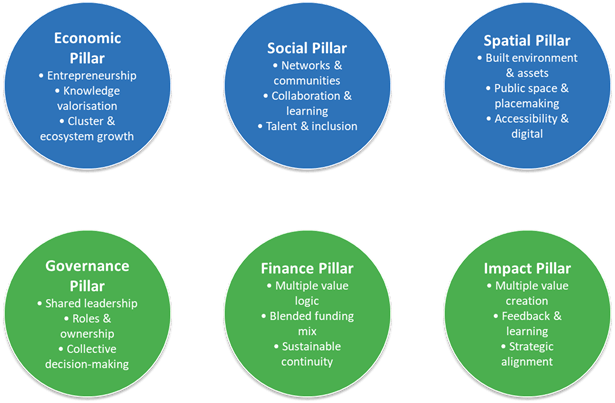
Figure 1: six pillars that form a flexible, learning and adaptive development strategy
These substantive pillars are linked to three supplementary pillars: governance, finance, and impact. These pillars describe not so much the content of the organised innovation space as how it is addressed: how choices are organised, how resources and investments are secured, and how effects are made visible and fed back into the learning and development process. Together with the substantive pillars, they form the foundation of a flexible development strategy that provides direction without rigidity, allows room for context, timing, and growth, and provides a framework for decision-making, collaboration, and long-term development.
The economic pillar
The economic pillar forms the key productive engine within the substantive core of the organised innovation space. This pillar encompasses the entire set of organisations, activities, and relationships that generate new knowledge, stimulate entrepreneurship, and translate innovation into economic and societal value. This involves the interplay between innovation drivers (such as universities, research institutions, medical and technological centres, corporate R&D departments, and knowledge-intensive companies) and a second layer of innovation cultivators, including incubators, accelerators, shared labs, proof-of-concept facilities, tech transfer structures, investor networks, and specialised support services. Together, these actors ensure that knowledge is not only generated but also circulates, is tested, scaled up, and embedded in new products, services, and businesses.
The economic pillar, therefore, focuses on strengthening the entrepreneurial dynamism of knowledge-intensive companies, with attention to the entire entrepreneurial lifecycle: from early innovation and experimentation, through start-up and scale-up, to further development, consolidation, and, where necessary, controlled exit. Key elements include:
- Formulating a clear knowledge base and technological focus, without rigid boundaries but with strategic direction.
- Facilitating convergence between sectors and disciplines, so that new combinations and application domains can emerge.
- Creating an optimal mix of established companies, start-ups and scale-ups, with mutual complementarity in functions and positions.
- Access to capital, investor relations and growth programmes that bridge risk and development phases.
- Programmatic and spatial structures that enable growth and exit strategies, without weakening the ecosystem.
Understanding the importance of proximity, spillovers, and the interaction between entrepreneurship, research, and application, this is translated into a conscious organisation of valorisation processes in the economic pillar. The pillar focuses on strengthening the links between research, prototyping, market validation, and commercialisation, and on developing instruments and environments where:
- Knowledge can be exchanged between companies, education and research.
- (Digital and physical) test environments accelerate innovation.
- Shared facilities reduce transaction costs and stimulate collaboration.
- Talent and entrepreneurship come together in learning and working practices.
This means the economic pillar explicitly goes beyond quantitative growth. It focuses on the quality and structural anchoring of innovation, on strengthening regional cluster strength, and on connecting economic development with broader societal and transition challenges. The economic pillar thus constitutes not only the productive engine of the organised innovation space but also the strategic driver of long-term value creation – in close interaction with the social and spatial pillars of the ecosystem.
The social pillar
The social pillar forms the relational and cultural foundation of the organised innovation space. In line with the social/networking assets, this pillar describes the entire set of relationships, interactions, partnerships, and communities that sustain and give meaning to the ecosystem. While the economic pillar focuses on entrepreneurship, business dynamics, and knowledge valorisation, the social pillar focuses on the human and social conditions within which collaboration, trust, exchange, and collective learning can develop.
Within this pillar, the organised innovation space is not conceived as a collection of organisations, but as a shared ecosystem. The social infrastructure consists of both formal and informal networks. On the one hand, these are close-knit, domain-specific structures – research consortia, cluster organisations, communities of practice, and project coalitions – where collaboration deepens, knowledge is secured, and mutual trust can grow. On the other hand, the social pillar encompasses a broader layer of weaker, more open connections, where encounters, serendipity, and cross-sector perspectives emerge, for example, through networking events, cross-disciplinary programming, hackathons, inspiration sessions, and open learning and working environments. This combination of strong and weak connections forms the relational capital that enables innovation ecosystems to learn, connect, and innovate flexibly.
The social pillar is deliberately organised programmatically within the conceptual framework; networks do not arise spontaneously but must be actively established and maintained. This is done by:
- Bringing the ecosystem together through structured meetings and learning programmes.
- Activating creativity, identity and joint culture formation.
- Encouraging education, training and skills building.
- Programming both social and professional activities.
- Promoting inclusion and diversity in access and participation.
In this way, networking does not become a separate activity. Still, an ongoing, organised practice – embedded in the rhythm of the place and supported by the community that works, learns and does business there.
Furthermore, the social pillar encompasses talent development and participation. The social pillar focuses on expanding access to opportunities across diverse groups and educational levels. This is achieved through work-study pathways, internship programs, skills programs, talent development, and the integration of educational institutions with entrepreneurship and research practices. This prevents the organised innovation space from developing into a closed knowledge enclave; instead, it creates an inclusive learning environment in which knowledge sharing, social mobility, and reciprocity are central.
In this sense, the social pillar not only supports innovation but also creates the conditions for trust to grow, collaboration to deepen, and shared values to develop. The social pillar thus strengthens the learning and adaptive capacity of the ecosystem and, in close interaction with the economic and spatial pillars, forms the cultural and relational framework within which the organised innovation space can develop sustainably.
The spatial pillar
The spatial pillar forms the physical foundation of the organised innovation space. In line with the previously mentioned physical assets, this pillar focuses on creating an environment that facilitates proximity, collaboration, and knowledge exchange. The spatial pillar, together with real estate, area development, public space, accessibility, and digital infrastructure, forms a cohesive urban and functional whole.
Within this pillar, the organised innovation space is viewed as a consciously designed spatial ecosystem in which the built environment not only provides the backdrop for economic and social dynamics but also serves as an active instrument for amplifying them. The pillar encompasses both private and public spaces – from research buildings, labs, business premises, and mixed-use urban programs to squares, streets, campuses, and collective interiors – and the structures that connect these places. The emphasis is on proximity, accessibility, and the diversity of spatial typologies, so that encounters, interactions, and informal knowledge exchange can occur naturally in the space’s daily use.
The spatial pillar guides how real estate development and area development serve as strategic building blocks of the ecosystem. This involves creating a functional and programmatic mix in which:
- Work and research environments are combined with supporting and public functions.
- There is room for growth, scaling up and flexibility in programming and use.
- Different spatial scales (start-up, scale-up, corporate, shared facilities) and functions (R&D, test beds, small-scale production, etc) can coexist.
- New buildings are carefully embedded in the existing urban fabric.
In this context, real estate development is not primarily driven by individual buildings but by the area’s collective functioning.
Furthermore, the design of public space is a crucial component of the spatial pillar. Public space is not seen as a residual area between buildings, but as an active social and learning environment – a place where informal encounters, exchanges, and experiments can take place. Squares, parks, entrance areas, accessible streets, and semi-public inner worlds function as so-called ‘collision spaces’ where professionals, students, researchers, entrepreneurs, and residents can encounter each other, both planned and by chance. These spaces are deliberately designed to be inclusive, accessible, and high-quality living environments that contribute to the identity, recognisability, and placemaking of the organised innovation space.
The spatial pillar also encompasses the infrastructure and accessibility layers, both physical and digital. Multimodal accessibility – via public transport, bicycles, slow-moving traffic, and regional connections – is considered a prerequisite for proximity, talent mobility, and sustainable accessibility. At the same time, digital infrastructure – broadband networks, data connections, smart grids, and digital research facilities – is an equally essential part of the spatial structure, as it enables collaboration and knowledge sharing, even beyond physical proximity. Therefore, the pillar focuses on multilayered connectivity, in which physical mobility and digital connectivity mutually reinforce one another.
In this sense, the spatial pillar functions as the backbone of the ecosystem: it connects buildings, programs, networks, and users into a single, recognisable environment in which economic and social processes are literally given space to develop. By approaching real estate development, area development, public space, infrastructure, and digital systems coherently, the result is not a collection of disparate projects, but a coherent, adaptive, and future-proof spatial framework that enables the organised innovation space to renew itself, grow, and permanently anchor itself in its urban and regional context.
Integration into the development strategy
The three substantive pillars – economic, social, and spatial – do not function as standalone domains. They should be part of a flexible development strategy in which, in addition to the substantive pillars, three supplementary pillars guide the organisation and implementation of the whole: governance, financing, and impact.
These pillars describe not so much what the organised innovation space is, but how it is shaped and sustained over time – how decisions are made. Interests are aligned (governance), how resources, investments, and continuity are secured (financing), and how results are made visible, fed back, and used for further development (impact). In this sense, these three pillars indicate how the substantive pillars are addressed: how economic, social, and spatial choices are coordinated; how they adapt to changing circumstances; and how they become part of an iterative learning and development process.
Together, the three substantive and three organisational pillars form the foundation of a flexible development strategy. This strategy provides stability without rigidity, acknowledges complexity without reducing it, and enables the organised innovation space to grow adaptively, in line with its context, partners, ambitions, and lessons learned. A set of development principles that details all six pillars is usually part of the development strategy.
The governance pillar
The governance pillar describes how an organised innovation space is organised, led, and supported by the parties involved. The governance pillar focuses on how choices are made, how interests are aligned, and how shared direction and implementation power are organised. Governance is not conceived as central direction, but as the ability to organise collaboration, shared orientation, and coordinated action in a context with multiple owners, institutions, and stakeholders.
In line with international insights on the governance of innovation ecosystems, this pillar focuses on preventing fragmentation and integrating separate programs, investments, and development lines into a single, cohesive development movement. Effective governance emerges when parties learn to take joint leadership, formulate shared ambitions, and establish mechanisms that enable them to decide, prioritise, and invest across institutional and sectoral boundaries. This allows for various organisational forms, depending on the context, ownership, and development phase, ranging from informal coalitions to more structured alliances or independent implementation organisations.
In that light, the governance pillar explicitly addresses questions such as:
- Who is ‘at the table’ and has decision-making power?
- How do different types of actors participate?
- How do public and private roles relate to each other?
- How is diversity of perspectives and interests safeguarded?
In addition, this pillar pays special attention to how governance relates to land, real estate and area development. This makes area development not only a physical, but also an institutional and strategic instrument within the ecosystem.
Finally, the governance pillar focuses on organisational form over time. Key considerations include:
- Co-design and co-investment between partners.
- The balance between independence and public anchoring.
- Financially sustainable organisational forms.
- Flexibility and adaptability in successive development phases.
The governance pillar thus functions as the organising principle that brings together the substantive pillars, ensures their mutual coherence, and enables the ecosystem to operate collectively, learning, and adapting. The term often used when discussing the role of a management organisation in an organised innovation space is that of ‘active steward.’
The financing pillar
The financing pillar focuses on how an organised innovation space is financially supported, developed, and maintained. It describes how the preconditions for continuity, growth, and joint investment power are made. Financing is not conceived as the sum of individual project budgets, but as a strategic structure that enables long-term support for programs, organisations, real estate, facilities, and experimentation.
A key principle within this pillar is the use of an area-wide business case. Instead of focusing solely on financial returns per object or project, value creation across the entire ecosystem – economic, societal, social, and spatial – is considered. This means that public, private, and societal benefits are considered in conjunction, and that investments can be linked to goals such as innovation, talent development, placemaking, entrepreneurial dynamism, and programmatic continuity.
This means the financing pillar emphasises developing a diversified structure where various sources and instruments support each other, including public investment, contributions from partners, real estate revenues, innovation programs, funds, and private capital. These should be interconnected within a shared framework to spread risks, reduce reliance on subsidies, and ensure long-term stability.
A second core component of this pillar concerns the financing of the ecosystem as an organisational structure. Not only physical projects or programs require resources, but also:
- The organisational and governance structure.
- Programmatic collaboration and networking.
- Community development and knowledge sharing.
- Experiments, pilots, and learning paths.
The financing pillar recognises that this type of ‘invisible infrastructure’ is crucial to the functioning of the organised innovation space and should therefore be supported in a structural and sustainable manner, rather than on a project basis.
Furthermore, the relationship between financing and development phases is key. At different stages – build-up, growth, consolidation – different forms of financing, different risk profiles, and different payback periods are appropriate. Therefore, the pillar encourages an adaptive financing logic, with room for:
- Early-stage investments and experimentation.
- Further development and scaling up.
- Long-term management and program models.
Finally, the financing pillar serves as a steering mechanism: it helps set priorities, connect collaborative partners to shared goals, and direct investments toward activities that both strengthen the ecosystem and deliver social and economic value.
The impact pillar
The impact pillar focuses on how the effects of an organised innovation space are understood, measured, discussed, and utilised, and describes how results are made visible and meaningful to stakeholders and the wider environment.
Within this pillar, impact is not reduced to a limited set of indicators or economic output but instead conceived as a multifaceted value concept. This includes:
- Economic and entrepreneurial development.
- Knowledge production, innovation, and valorisation.
- Social and societal impact.
- Talent development and participation opportunities.
- Spatial and urban transformation.
- Networking and collaboration quality.
The impact pillar emphasises the development of a structured feedback and reflection cycle. In this case, impact measurement is not a final report or accountability tool, but an active practice that:
- Provides insights for strategic choices.
- Shows where the ecosystem is strong and where strengthening is needed.
- Nourishes collaboration between partners with shared knowledge.
- Makes learning experiences explicit and transferable
A key component of this pillar is that impact is linked to programming, financing and governance. By allowing impact results to flow back into decision-making and investment considerations, a learning development mechanism is created in which:
- Priorities can be periodically recalibrated.
- Programs can be adapted or scaled up.
- New interventions can be designed based on practical experience.
- Partners share responsibility for outcomes.
This means that impact is not only measured but actively used as management information.
Conclusion
There is no uniform blueprint for developing an organised innovation space. Every environment has its own history, institutional relationships, economic dynamics, spatial conditions, and social reality. This conceptual framework, therefore, does not pretend to offer a fixed recipe, but instead provides a framework that recognises and structures the complexity of such environments. By developing the economic, social, and spatial pillars integrally – and connecting these with coherent choices regarding governance, financing, and impact – a development approach emerges that does not simplify or reduce but instead honours the multiplicity and layering of practice and context.
At the same time, the success of an organised innovation space does not stem solely from the presence of a conceptual framework, but rather from how it is interpreted, applied, and further developed in practice. It is essentially the specific context – and especially the accumulated experience in dealing with the various pillars, balancing interests, and learning from iterative development steps – that determines whether the ecosystem can truly grow into a strategic, learning, and resilient constellation. In this light, the conceptual framework is not an endpoint, but a framework that provides direction for a continuous development process, the outcome of which is always local, situational and relational.

