
Demonstrating the impact of organised innovation spaces
Tom Straeter, Innovative Places
This blog is published as a chapter in the book by Jacques van Dinteren and Paul Jansen (eds,) ‘Organised Innovation Spaces’. Nijmegen: Innovation Area Development Partnership (2026). The book will be digitally available in autumn 2026.
This article focuses on one of the most important development principles of organised innovation spaces: demonstrating the impact of these innovation areas, including innovation districts, science parks, campuses and incubators. The urgency to demonstrate the effects of an innovation space has increased significantly in recent years. In contrast, until a few years ago, the usefulness and necessity of doing so were far less widely recognised. This article examines the impact of organised innovation spaces from the perspective of the management organisations within these areas. It outlines key trends and developments in impact reporting for organised innovation spaces over recent years, the challenges and limitations associated with demonstrating impact, and provides guidance and recommendations on preparing such an impact report.
In this article, the impact of organised innovation spaces is understood to encompass both the direct and indirect effects of activities aimed at developing these areas. The focus is usually on the economic and societal impact, not only on the innovation area itself but also on the broader region where it is located.
Making the impact of innovation areas visible can be approached from different perspectives. Various types of organisations carry out activities that contribute to this impact while pursuing other objectives.
The primary perspective is that of the organisation responsible for developing and managing an innovation area (hereinafter, the management organisation). This often concerns ecosystem development, also referred to as socio-economic programming. Well-known examples include Stichting Utrecht Science Park, High Tech Campus Eindhoven Site Management B.V. and Kilometro Rosso Innovation District. Some of these organisations are also responsible for developing the physical area. From the perspective of a management organisation, impact is measured by the extent to which it has achieved the intended objectives for socio-economic programming and/or the physical area, and by the degree to which this has made the innovation area more successful.
Other relevant perspectives are those of the users of organised innovation spaces, such as R&D companies and knowledge institutions (educational and research institutes), as well as those of facilitators: organisations that create the conditions for a well-functioning innovation space. Examples include providers of incubator and accelerator programmes, as well as real estate investors and developers. The following two examples illustrate the diversity of these perspectives.
First, R&D companies. These often play an active role in strengthening the ecosystem and, consequently, the conditions for their own success. This takes place in various ways, for example, by actively promoting the proposition of the innovation space, being involved in the operation of shared research facilities and incubator and accelerator programmes, and committing to issues such as multimodal accessibility, the level of amenities within the innovation space, and housing for staff in the vicinity. For such companies, it is important to gain insight into the effects of their efforts and the extent to which these contribute to their core activities.
A second example concerns real estate investors and developers. An increasing number of these parties invest directly in the development and management of the ecosystem in which they develop and operate real estate. They do so, for example, by deploying ecosystem and community managers who aim to help tenants succeed by connecting them, organising events, or even setting up innovation programmes. They also seek to attract and retain potential tenants. For these organisations, it is crucial to measure whether these investments are recouped through improved occupancy rates and higher real estate values. This, however, is not an easy task. Practice shows that it is difficult to demonstrate the direct effects of in-kind‑and cash investments on organisational success. This means that these organisations also require a certain degree of belief and trust that the investments contribute to the desired outcomes.
Although these are two relevant examples, this article focuses on the impact of the management organisations of innovation areas. These organisations are also referred to as ‘orchestrators’. Examples include non-profit organisations such as Stichting Utrecht Science Park, Stichting Leiden Bio Science Park and Campus Groningen, as well as commercial parties such as High Tech Campus Eindhoven Site Management B.V. and the Canary Wharf Group. For these management organisations, it is important to measure the extent to which the activities they undertake to develop and manage the organised innovation space affect the area’s success.
Why is demonstrating the impact of innovation areas so important?
Although an increasing number of management organisations of organised innovation spaces recognise the importance of impact measurement, relatively few publish impact reports. There are several reasons for this.
First, measuring the effects of activities is perceived as complex. Many management organisations are unsure how to approach this (later in this article, we explain how an impact report can be prepared). Second, these organisations have a broad range of responsibilities and limited resources. Most time and attention is devoted to activities that directly contribute to the development of the innovation area, such as setting up innovation projects and community management. As a result, impact measurement is often an additional task that receives insufficient attention.
An important reason for writing this article is precisely to emphasise the importance of impact measurement. For management organisations, it is essential to demonstrate what effects their efforts actually generate. At a general level, there are several reasons why, in principle, every management organisation should publish an impact report.
Demonstrating legitimacy and ensuring the continuity of the management organisation
Insight into impact helps management organisations substantiate their legitimacy and thereby ensure their continued existence.
For foundations (the most common form of non-profit management organisations), it is the executive directors’ task to account to the supervisory board. This is often done through annual reports that provide a concise factual description of activities but offer little insight into actual effects. An impact report provides a far more powerful, comprehensive and transparent picture of what the organisation has actually achieved. In addition, foundations often depend on subsidies and partner contributions for their funding. By clearly demonstrating the effects of deployed resources, subsidies and partner contributions can be better justified and secured for the longer term. A similar dynamic applies to commercial parties, such as real estate developers and investors: they, too, must demonstrate to their boards and shareholders the value their efforts generate. For them, this is particularly challenging because the expected direct effect is difficult to make visible.
Refinement of strategy and action plan
Measuring impact is an essential tool for management organisations to evaluate the effectiveness of their current strategy. By analysing the extent to which strategic choices and the associated action plan contribute to achieving predefined objectives, insight into policy effectiveness is gained. If impact measurement shows that specific objectives are not being achieved sufficiently with the current approach, this provides a basis for adjusting objectives or opting for an alternative strategy and adapted activities.
Strengthening the proposition of the innovation area
Making impact visible is also highly important for the positioning of management organisations and, consequently, the organised innovation space. A management organisation that can not only show which companies are located there, which programmes exist and which facilities the area offers, but also demonstrate the benefits that organisations located in the organised innovation space derive from this, has a significantly stronger and more attractive proposition.
A clearly substantiated impact proposition makes it easier to attract new organisations, grow the ecosystem and convince stakeholders to invest in strengthening the innovation area. This includes, for example, persuading developers of housing for R&D companies within the organised innovation space. An impact report demonstrating that the space has a strong, flourishing ecosystem will increase these parties’ willingness to invest. An innovation space that can demonstrate its impact, therefore, has a significant advantage over competing areas that cannot.
In short, demonstrating impact is not a luxury but a strategic necessity. It provides direction, legitimacy and capacity for action, and thus constitutes a crucial success factor for every organised innovation space.
Trends and developments: how have impact reports evolved in recent years?
Nevertheless, as of 2025, not all management organisations demonstrate the impact of the organised innovation space. For example, only a few of the thirteen Dutch campuses and science parks designated as mature by the Ministry of Economic Affairs have their own impact report. That said, an upward trend has been observable in recent years. Impact reports have, over the past few years, become an important instrument for monitoring, accounting for, and communicating the performance of innovation areas. This development aligns with the broader professionalisation of campus management and the growing need to interpret and explain the effects of organised innovation spaces.
When examining impact reports on organised innovation spaces in the Netherlands, Europe, and the United States over recent years (approximately up to ten years ago), several trends and developments can be identified. An overview of the most important trends and developments is provided below.
Professionalisation of format and presentation
Until a few years ago, many impact reports of organised innovation spaces resembled traditional annual reports, with considerable emphasis on financial reporting. We also observe that some innovation spaces presented results and effects in the form of a factsheet. Examples can be found at, among others, Utrecht Science Park and Tech Parks Arizona (Stichting Utrecht Science Park, 2025; and The University of Arizona TechPark, 2019).
Impact reports often resembled economic impact studies. The emphasis was on quantifying direct and indirect economic value added for both the campus itself and the surrounding region. Examples of such reports include: Leiden Bio Science Park – Baseline measurement of the economic significance of LBSP; Research Park University of Illinois – Economic Impact Report 2018; NL Space Campus – Economic significance of the space cluster Noordwijk; and WaterCampus Leeuwarden – WaterCampus Monitor 2023. These reports focus primarily on indicators such as employment, gross regional product (GRP) and sectoral economic growth (Decisio, 2023; RPC Champaign County Regional Planning Commission, 2018; Decisio, 2025; and Wetsus et al., 2023).
In recent years, a clear trend has emerged in which impact reports are published as magazines and even books. These are intended not only for external target groups (such as companies, knowledge institutions, and investors) but also for internal stakeholders (board members, shareholders, and employees). Characteristic features of these publications include strong data visualisation, extensive narratives, value stories and testimonials from entrepreneurs, researchers and partners. Examples of innovation spaces that demonstrate this are Brightlands Chemelot Campus with Impact Magazine 2023 and Security Delta (HSD) with 10 years of HSD: anniversary book (Brightlands Chemelot Campus, 2023; and HSD, 2023).
In addition, video and audio fragments are increasingly integrated into impact reports through interviews and podcasts. A striking example is the Here East Impact Report 23/24 (Here East, 2025).
With the shift towards professional, visually attractive publications, impact reports increasingly also function as strategic marketing and communication instruments. They are regularly used as the ‘billboard’ of the organised innovation space.
Furthermore, several organised innovation spaces have developed online dashboards with up-to-date data on the community and the area. An example of this is the Campus Groningen Dashboard (campus.groningen.nl, 2025).
Substantive broadening of impact reports
Impact reports nowadays cover a much broader range of indicators than a few years ago. In addition to classical metrics such as the number of organisations and jobs, data are increasingly collected on community development, socio-economic programming (including innovation projects), area development and real estate, visitor numbers, and even the number of cups of coffee consumed at places where the community usually gathers.
Sustainability indicators are also becoming increasingly prominent in impact reports of organised innovation spaces. These include indicators that provide insight into the extent to which contributions are made to the energy transition and climate adaptation, as well as indicators that reflect levels of inclusivity, diversity and equality within the innovation space. Examples of spaces focusing on these aspects include: Brightlands Chemelot Campus – Impact Magazine 2023, ASR Dutch Science Park Fund – ESG Annual Report 2024, CIC – ESG Annual Report 2024 (Brightlands Chemelot Campus, 2023; a.s.r. real estate, 2025; CIC, 2020; and Enjoy-work, 2024).
We also observe that impact reports increasingly focus not only on the performance of the innovation area itself, but also on regional economic effects, such as employment growth and regional productivity. Examples include: Research Triangle Park – Economic Impact Study and Leiden Bio Science Park – Baseline measurement of the economic significance of LBSP (Research Triangle Park, 2024; and Decisio, 2023).
In recent years, impact reports on organised innovation spaces have evolved from relatively simple economic impact studies into professionally designed reports that feature a diverse set of indicators. The broadening in both form and content demonstrates that impact reporting is becoming increasingly important for management organisations.
Challenges and limitations in measuring impact for innovation areas
As noted in the first section, demonstrating the (direct) effects of activities aimed at developing and managing an innovation area is complex. A key challenge is collecting sufficient, relevant data. This process often requires substantial time and resources, while data availability is frequently limited, and data quality is not always adequate.
In addition, establishing a causal relationship between the activities of the management organisation and the development of the organised innovation space is difficult. For example, it is challenging to determine the extent to which employment growth among established organisations can genuinely be attributed to management efforts, or whether it would have occurred in the absence of these interventions. According to Bearse (1998) and Phan et al. (2005), among others, this is partly due to methodological challenges. Often, an appropriate control group is lacking, leading to so-called selection bias, in which the organisations studied are not representative of the entire population.
Furthermore, impact measurements often focus solely on positive effects. At the same time, potential negative consequences of the development of the innovation area (e.g., traffic congestion or increased pressure on the regional housing market) are frequently disregarded. This is partly because the management organisations themselves typically initiate impact measurement.
Finally, management organisations need to be aware that producing an impact report requires a significant investment of time and resources.
Step-by-step plan: how to make the impact of an organised innovation space visible?
Now that it is clear why making the impact of management organisations’ activities visible is essential, as well as the challenges this entails, the question arises of how this impact can be monitored in practice. The step-by-step plan below provides a structured approach that reflects the complexity and diversity of organised innovation spaces.
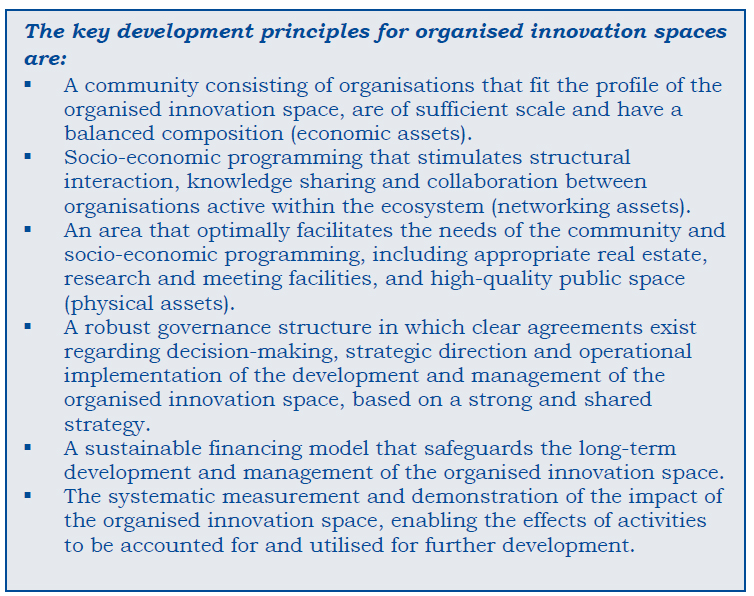
Define clear ambitions, objectives, strategy and associated activities
Making impact visible begins with defining what constitutes a successful organised innovation space. Management organisations should, in collaboration with key stakeholders, formulate the ambition and objectives of the innovation area. Once these objectives are clearly and ‘smartly’ formulated, they can be translated into a strategy that centralises development principles and underlying success factors. A sustainable strategy is based on these principles and serves as the foundation for an activity plan that specifies the concrete actions required to realise the objectives.
Define the indicators for impact measurement
For the formulated objectives and associated activity plan, appropriate indicators should be established to measure progress and the impact of activities. This can be done quantitatively using collected data. In addition, impact can be interpreted qualitatively, for example, by narratively demonstrating the outcomes of innovation programmes and projects and by using testimonials from organisations within the organised innovation space. Narratively illustrating which visits and meetings have been organised is also relevant. Combining both approaches generally yields the most comprehensive picture of realised impact.
Collect and analyse information and data
Once indicators are established, data collection can begin. This is typically achieved through multiple sources and methods. A recommended approach is to periodically survey organisations in the innovation space. This enables the collection of data on, among other things, employment, turnover, R&D investments, patents, and participation in innovation projects. It is advisable to repeat this survey at least every two years and to maintain a consistent questionnaire to build a longitudinal dataset.
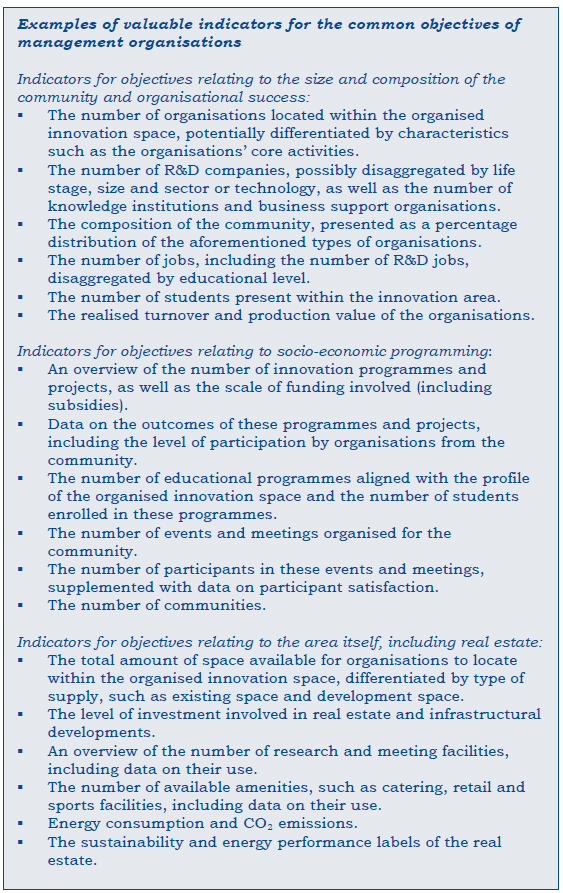
In addition, structured interviews provide valuable, complementary qualitative insights, for example, on successful innovation projects and the perceived added value of the ecosystem. Given that the availability of quantitative data for various indicators is often limited, this is an effective way to make (direct) impact visible.
Furthermore, internal (meta)data of the management organisation can be used, such as event attendance figures, use of research facilities or other operational data. External parties also often possess relevant data, such as figures on investments raised by start-ups and scale-ups or labour market data.
Prepare, publish and distribute the impact report
Based on the collected quantitative and qualitative data, the impact report can be prepared. It is advisable to publish both a digital (online) version and a printed version. In addition to textual explanations, the visual presentation of results deserves explicit attention, for example, through infographics or supporting images. In the online version, videos can also be included, such as event impressions or a summary video. An increasing number of management organisations also make use of podcasts as an additional communication tool. Finally, a well-designed, accessible report layout is crucial for reaching and persuading both internal and external stakeholders.
When preparing the impact report, it is important to carefully consider the intended audience, which in practice often consists of multiple target groups. These typically include both internal and external stakeholders. For internal stakeholders, such as the executive board, board members, shareholders and employees, the report must provide structured, clear and factual insight into the extent to which the stated objectives have already been achieved. External stakeholders form a more diverse group and include, among others, organisations already located in the innovation area, potential new users, service providers, management organisation partners, and local and regional authorities. For these parties, the impact report serves not only as an accountability instrument, but also as an important communication tool and ‘billboard’ of the management organisation to (continue to) convince them of the added value of the innovation area.
This step-by-step plan thus provides a straightforward methodology that enables management organisations to systematically and substantively demonstrate the impact of their organised innovation space.
Conclusion and recommendations
The increasing professionalisation of organised innovation spaces has led to more management organisations preparing annual impact reports. The necessity of such reporting is increasing, as these reports play a crucial role in informing and convincing stakeholders and financiers of the added value of activities that contribute to the development and management of these innovation areas. Moreover, the number of innovation spaces continues to grow, making a robust, well-substantiated impact report an important tool for distinguishing oneself from comparable initiatives.
Despite this growing urgency, preparing an impact report remains a task that requires specific expertise and substantial resources and entails challenges in data collection and analysis. However, the investment involved can be fully recouped, as the report contributes to strategic objectives, legitimises activities, and strengthens the case for the organised innovation space. This underscores the importance of structurally incorporating impact reporting into the annual activity plan of every management organisation.
Finally, the key recommendations for management organisations of organised innovation spaces about preparing an impact report are as follows:
- Start the step-by-step plan for the impact report at an early stage. As soon as the one-year report is published, preparation for the next should begin. Prepare an impact report at least once every two years.
- Producing an impact report requires a significant investment of time and financial resources. Ensure that sufficient resources are included in the management organisation’s budget.
- A valuable impact report can only be produced when the management organisation has clear objectives and a strong strategy. Use these as the basis for determining appropriate indicators.
- Be creative throughout the entire process: in selecting indicators, collecting both quantitative and qualitative data, and in designing and visualising the report. An engaging and well-designed report significantly increases the impact of the findings.
- Devote substantial attention to the publication of the report. Carefully consider the different target groups and the different approaches this may require. Communicate the results not only internally, but also to external stakeholders. Integrate the findings into the proposition for established organisations, potential new users of the organised innovation space and other relevant parties.
References
- a.s.r. real estate (2025). Investing in perpetual value – ASR Dutch Science Park Fund – ESG Annual Report 2024.
- Bearse, P. (1998). A Question of Evaluation: NBIA’s Impact Assessment of Business Incubators. In: Economic Development Quarterly, volume 12, issue 4, pp. 322-333.
- Brightlands Chemelot Campus (2023). Act for tomorrow’s life. Impact Magazine, Edition 2023.
- Campus Groningen (2025). Campus Groningen Dashboard.
- CIC (2020). Global Impact Report – Meeting the Moment & Forging the Future 2020.
- Decisio (2023). Meting economische betekenis Leiden Bio Science Park – eindrapportage.
- Decisio (2025). Economische betekenis ruimtevaartcluster Noordwijk – eindrapportage.
- Enjoy-work (2024). ESG Annual Report 2024 Chiswick Park.
- Phan, P., Siegel, D. and Wright, M. (2005). Science parks and incubators: observations, synthesis and future research. In: Journal of Business Venturing, volume 20, issue 2, pp. 165-182.
- Here East (2025). Growing Our Global Impact – Here East Impact Report 23/24.
- HSD (2023). Jubileumboek: 10 jaar HSD.
- Research Triangle Park (2024), RTP Economic Impact Study Executive Summary.
- RPC Champaign County Regional Planning Commission (2018). University of Illinois Research Park Economic Impact Report 2018.
- Stichting Utrecht Science Park (2025). Factsheet Utrecht Science Park.
- The University of Arizona TechPark (2019), 2019 Economic Impact of the UA Tech Park.
- Wetsus European Centre of Excellence for Sustainable Water Technology, Water Alliance, Centre of Expertise Water Technology (2023), WaterCampus Monitor 2023.
 Innovation Area Development Partnership (IADP)